
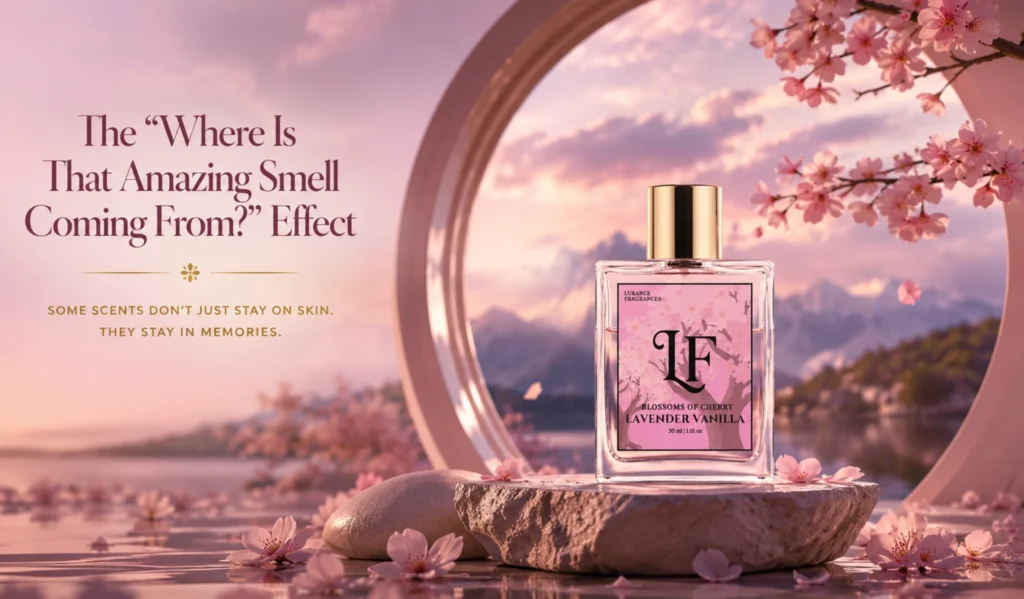
The "Where Is That Amazing Smell Coming From?" Effect
Most fragrances are smelled. Very few are remembered. Even fewer make strangers stop and ask questions. The difference is not loudness. It is something older and more instinctive than that.
The moment arrives without announcement. A conference room. A crowded lift. The second floor of a café on a Tuesday afternoon. Someone enters, or walks past, and the air changes in a way that is difficult to describe but impossible to ignore. Conversations pause. People glance around. Someone eventually asks the question out loud.
“Where is that amazing smell coming from?”
This is not a common event. Most fragrances, including expensive ones, pass through a room without registering on anyone other than the person wearing them. Understanding why a small number of fragrances consistently produce this reaction requires looking at something older and more instinctive than marketing.
How scent reaches memory
The olfactory system is the only sense with a direct neural pathway to the hippocampus and amygdala, the brain regions most responsible for memory formation and emotional response. Sight and sound travel along different routes, undergoing additional processing before reaching those areas. Scent arrives first and faster, which is why a fragrance encountered unexpectedly can produce an immediate emotional reaction before the conscious mind has had time to identify what it is responding to.
This is the neurological basis for the moment. The brain has registered something significant before the person has even decided to pay attention.
Projection versus presence
Not every noticeable fragrance is memorable. A sharp, aggressive composition can command a room without leaving any impression worth recalling. What creates the involuntary question is something more specific: a scent that projects enough to reach other people, but carries enough character to feel genuinely distinctive rather than simply loud.
“Memorability in fragrance is less about volume and more about structure. A composition with real depth keeps the nose engaged in a way that a one-dimensional opening cannot.”
When a fragrance becomes a presence
The Scent of Flowers from Lurance Fragrances illustrates this principle directly. The composition was built to remain present throughout a full day of outdoor exposure, commuting, and summer heat, using Indian ingredients and a formulation method designed specifically to hold structure under those conditions rather than fade within hours of leaving home. The goal was not a fragrance that impresses on first spray and then disappears quietly. It was one that continues to register on other people’s senses hours after application, maintaining enough projection and character to arrive in a room before its wearer does.
That quality is what turns a fragrance from something worn into something noticed.
What people actually remember
People rarely recall what someone was wearing at a dinner, a meeting, or a chance encounter. The outfit, the watch, the bag, these details blur and vanish. The scent, when it was the right one, often does not.
Sometimes a single fragrance, encountered unexpectedly on an ordinary afternoon, turns a passing moment into a memory that holds.