
What Your Workspace Smells Like Affects More Than You Think
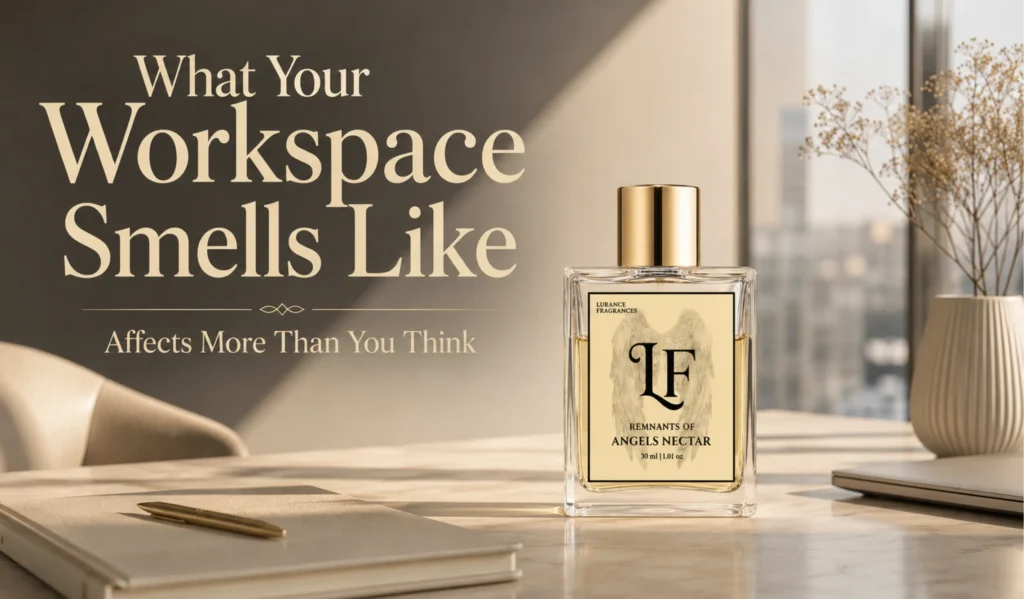
“The quiet variable that shapes how you work, how you feel, and how the people around you experience the room.”
Nobody puts fragrance on the list of things that determine how productive a day will be. It sits somewhere below the quality of the chair, the temperature of the room, the speed of the wifi, and approximately two hundred other things people discuss when they talk about working environments. And yet, without anyone quite realising it, scent is one of the most persistent influences on the quality of a workday.
It operates below the level of conscious attention. You do not sit down at your desk and think about what the air smells like. But your brain registers it. And that registration, happening quietly in the background of everything else you are doing, shapes your mood, your focus, and the way the day as a whole feels to you.
The Atmosphere You Actually Work In
Work carries its own particular weight. The deliverables are stacking up, the conversations that need to happen, the decisions that cannot be postponed, the pressure of knowing that the pace of a modern workplace rarely slows to accommodate how you are feeling on a given Tuesday. This is not a complaint about work. It is simply a description of what most people are actually navigating every single day.
Within that environment, the sensory conditions of the space matter more than they are usually given credit for. Lighting, sound, and temperature are well-documented influences on how people perform and feel at work. Scent belongs in the same conversation, but it rarely makes it there. What the air around you smells like during eight or nine hours of concentrated effort has a measurable effect on your stress levels, your ability to stay focused, and the baseline mood you carry through everything the day asks of you.
A workspace that smells clean and settled, anchored by a fragrance that is consistent and pleasant, creates a different internal environment from one that smells of nothing in particular, or worse, of something actively unpleasant. It accumulates across an entire day.
When The Wrong Scent Becomes The Problem
Most people have experienced a workspace where the olfactory environment was working against them without ever identifying it as the source of their discomfort. It might be a colleague’s overwhelming fragrance that arrives before they do and lingers after they leave. It might be two or three different scents competing in a shared space, none of them individually offensive but collectively producing something dissonant and fatiguing. It might be a fragrance that has turned sour after hours of heat and physical movement.
What these situations produce is a kind of background noise. Not audible, but present. The mind cannot fully settle because something in the immediate environment keeps pulling at its attention without ever being specific enough to address. Concentration fragments slightly. Patience thins a little faster. The ordinary stresses of the day feel slightly larger than they need to.
Clashing scents in a shared workspace are a specific version of this problem. The result is a space that feels subtly hostile to calm, focused work, even when everyone in it is trying their best. Scent compatibility in shared environments is something most offices never discuss, but its absence is felt every day.
What A Good Fragrance Actually Does For You At Work
Here is what changes when your personal fragrance is working well. The worry about how you are coming across physically disappears from your attention. You are not managing it in the background of conversations or recalculating whether to step closer or further from someone. That freed mental space returns to where it belongs: to the work itself.
That is not a minor thing. Pleasure is not something that should only exist outside of working hours. A scent that genuinely suits you, that you associate with clarity and composure, quietly anchors your state of mind across the hours you spend at your desk. The workspace stops feeling purely like a place where things are demanded of you. It starts to feel like a place where you can actually perform, and even, occasionally, enjoy the experience of doing so well.
People around you register this too, even if they cannot articulate what they are noticing. Someone who is composed, present, and comfortable in their own skin has a different quality of presence in a room. That quality is contagious in the best sense. It does not make anyone’s workload lighter, but it shifts the atmosphere slightly toward something that feels more human and less mechanical.
One Thing In Your Collection That Changes The Equation
This is exactly the context in which Lurance Fragrances was built to perform. A workspace fragrance needs to do something that most perfumes simply cannot manage: it needs to stay consistent across a full working day. Not just the morning version of itself. The same fragrance, the same quality, the same quiet presence, at hour two and hour six and hour eight.
The formulation behind Lurance was developed after 18 months of research and development, through thousands of experiments, with the specific goal of creating fragrances that hold up under the conditions real daily life produces. Heat from a long day indoors. The gradual physical accumulation of hours. The stress response that makes the body warmer. All of the variables that cause most fragrances to drift, thin, or disappear entirely before the working day is over.
Lurance fragrances do not thin under those conditions. What you smell like at 9 AM is genuinely close to what you smell like at 6 PM. That consistency matters in a workspace. It means the variable of how you are coming across physically stays settled for the entire day, not just the first part of it.
There is also something to be said for what a carefully chosen Lurance fragrance contributes to the immediate sensory environment of wherever you work. A scent with depth and character, worn by someone who carries it well, improves a shared space in the same way that a thoughtfully maintained desk or a well-chosen background for a video call does. It signals care. It signals intention. It creates a slightly more considered atmosphere around you without requiring anyone to acknowledge it directly.
“The workspace does not have to feel like a place of pure obligation. One small, consistent detail can shift the entire atmosphere of how you experience the hours you spend there.”