
The Most Common Fragrance Mistakes People Make During Indian Summers
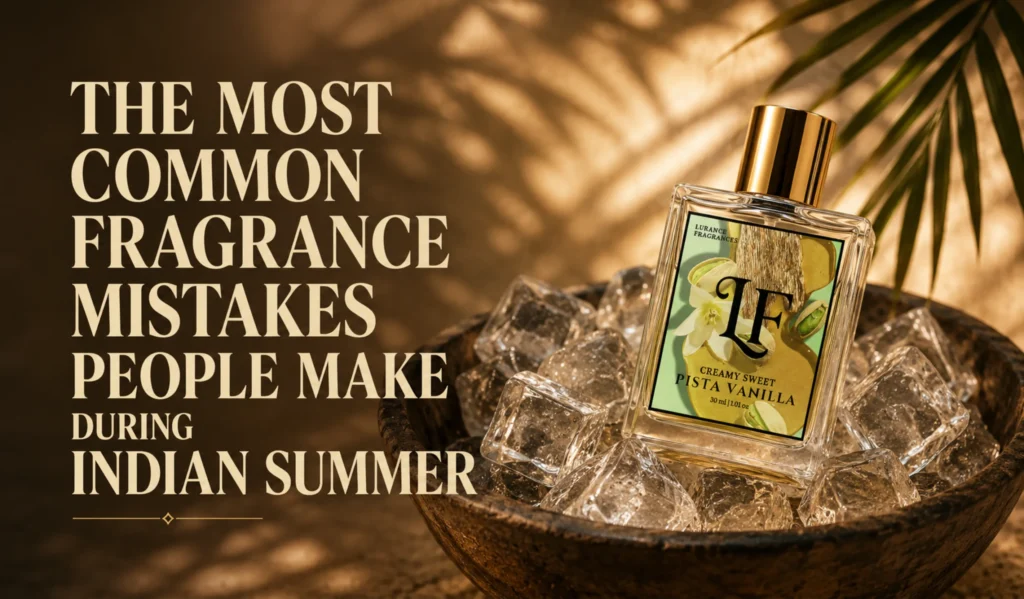
Indian summer is not a background condition for fragrance. It is an active test. Temperatures that make most formulations evaporate within the hour, humidity that shifts how a scent behaves on skin, and the physical demands of a day that begins early and ends late. And yet, most people continue to make the same set of fragrance choices under these conditions, experience the same disappointments, and then repeat the process the following season.
These are the mistakes that keep happening, and what each one actually costs.
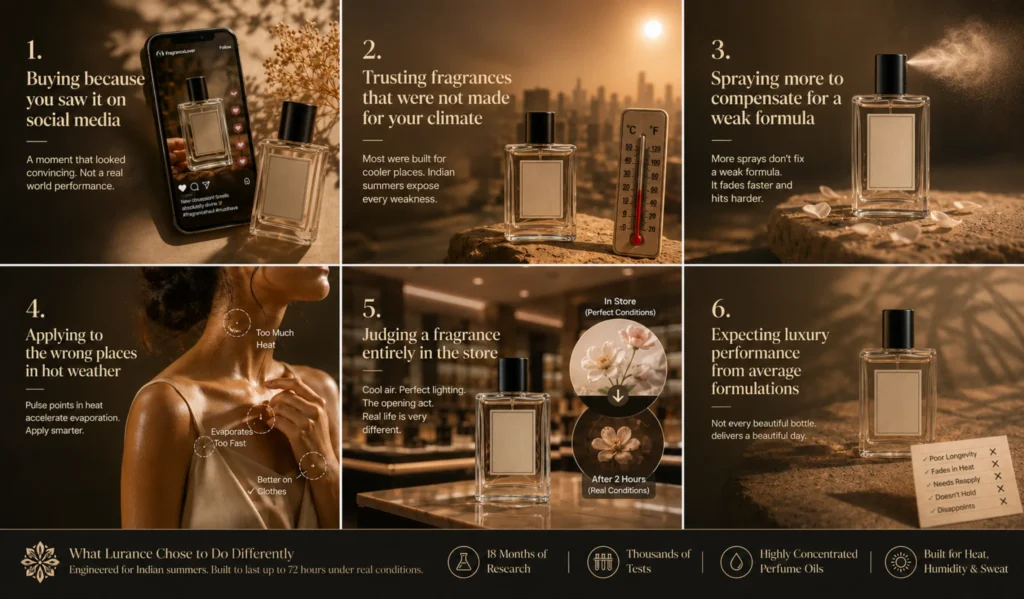
1. Buying because you saw it on social media
A creator posts a fragrance haul. The packaging looks beautiful in the lighting they have chosen. They spray it, they smile, they describe it with words that feel aspirational and compelling. Within a week, thousands of people had added the same bottle to their cart because something about the moment felt convincing.
What that moment never included was a genuine, extended, real-conditions testimonial. No one in a 30-second video is telling you how the fragrance performed at hour five on a 38-degree afternoon. They are telling you how it smelled when they first opened it.
2. Trusting fragrances that were not made for your climate
There is a category of knowledge about Indian summers that only accumulates through living inside them. The way the heat in April feels is categorically different from the way the heat in October feels. The way a body in motion through a crowded space in May creates a fragrance environment that no air-conditioned European testing facility was ever designed to simulate.
Most fragrances sold in India were not formulated with any of this in mind. They were developed for markets where 32 degrees is an extreme weather event. When those formulations encounter Indian summer conditions, they behave exactly as you would expect a product to behave when used outside the parameters it was built for. They evaporate faster than they should.
3. Spraying more to compensate for a weak formula
When a fragrance fades quickly, the instinctive response is to apply more of it. This is understandable and also largely ineffective. A perfume that is poorly concentrated will not perform better at higher volume. It will simply fade faster at higher volume, which occasionally produces the opposite problem: an overwhelming opening that dissipates entirely within the hour, leaving the wearer with no fragrance and everyone in the immediate vicinity with a memory of why they dislike heavy application.
4. Applying to the wrong places in hot weather
Pulse points are the standard advice, and in cooler climates, they make sense. In the Indian summer, pulse points are also the places where your body generates the most heat. Spraying directly onto wrists and neck in intense heat accelerates evaporation rather than projecting the fragrance. The result is a strong opening that burns off faster than it would if applied to slightly cooler areas or onto fabric.
5. Judging a fragrance entirely in the store
The environment inside a fragrance counter is engineered for one thing: the opening impression. It is cool, it is carefully scented in its own right, and it is designed to make everything smell more impressive than it will two hours later on warm skin in direct sunlight. Buying a fragrance without wearing it through at least a portion of a real day is buying the opening act and hoping the rest of the performance follows.
Many fragrances that smell extraordinary in the store reveal their limitations within the first hour of outdoor wear. The store was always showing you the best version of itself under ideal conditions. Real life is not ideal conditions.
What Lurance chose to do differently
Every mistake on this list exists because the industry has generally found it more convenient to allow these problems than to solve them. A fragrance that fades quickly drives repurchase. A consumer who over-applies uses their bottle faster and buys another sooner. The system works, in a commercial sense, precisely because the product does not work well enough for the person using it.
Lurance was built on a different premise. After approximately 18 months of research and development and thousands of formulation experiments, the objective was not to create a fragrance that performed well in a store or looked compelling in a social media post. It was to create something that held through Indian conditions because it was engineered specifically for them. Highly concentrated perfume oil compositions that do not evaporate under heat. Formulations tested against sweat, humidity, outdoor temperatures, and the long physical arc of an actual day. Fragrances built to last up to 72 hours under appropriate conditions.
That is what genuine appeal actually feels like. Not a performance put on for the first hour and quietly abandoned before the day reaches its most important moments. Something consistent, present, and entirely yours across all of it.
“A fragrance that was never built for your climate was never really built for you. The difference becomes clear the first time you wear one that was.”