
The Truth About Long-Lasting Perfumes
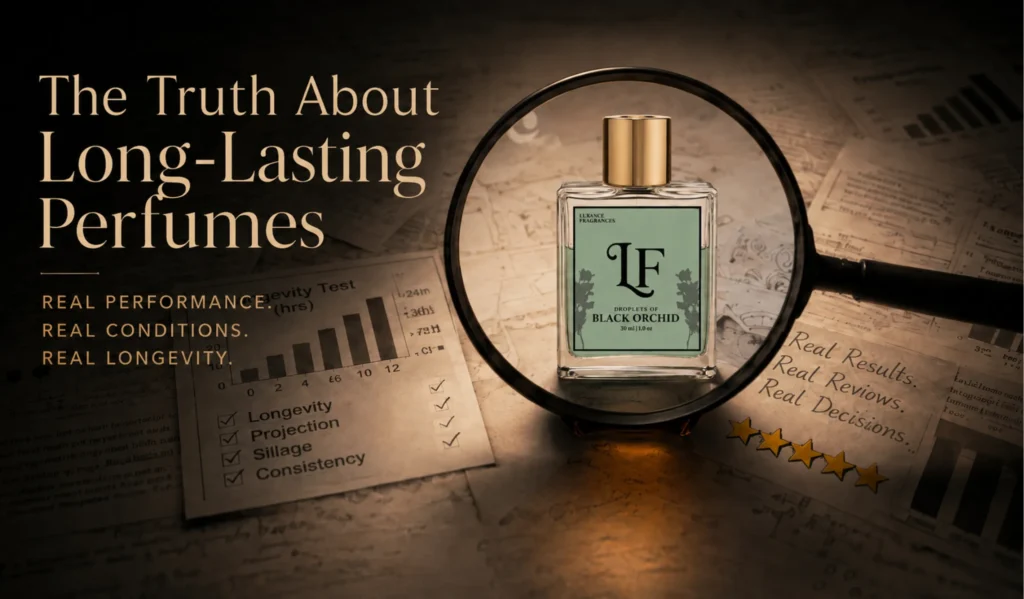
The Promise Most Perfumes Cannot Keep
“Long lasting” may be the most repeated phrase in fragrance marketing, and the most quietly broken.
Consumers have heard it on every shelf, in every advertisement, across every price point. And most have had the same experience: a fragrance that opens beautifully, commands attention for the first hour, then retreats so completely by midday that reapplication feels less like a choice and more like a requirement. The promise held in the store. The formula did not hold outside it.
The lab is not the street
Most longevity claims are established under controlled conditions. Indoor temperatures. Minimal physical activity. A testing environment calibrated to nothing resembling a Mumbai commute or an afternoon in Hyderabad in May. Under those conditions, a fragrance may genuinely perform well. The problem is that the conditions never follow the bottle home.
Heat accelerates the rate at which aromatic molecules leave the skin. Direct sunlight can alter the chemical structure of certain compounds entirely. Humidity changes how fragrance sits on skin and how the nose interprets it. Sweat shifts skin pH, which affects how base notes bond and how long they remain detectable. A formula that performed with genuine longevity in a climate-controlled room can behave like an entirely different product on a body moving through real Indian weather.
This is not always dishonesty on the part of manufacturers. It is a fundamental failure of context.
Why the formula itself is often the problem
Concentration levels matter, but they are only one variable. A fragrance built at high concentration but with structurally weak base materials will still fade quickly, because the molecules holding the composition together are not tenacious enough to resist evaporation under heat. Many brands invest in opening impressions, the vivid top notes that sell a fragrance in the first 30 seconds, without building the molecular foundation necessary to carry the scent through six or eight hours of actual use.
What makes a formula genuinely long-lasting is not a single ingredient or a single decision. It is the architecture of the entire composition, how each layer relates to the others, how resistant the base is to environmental stress, and whether the whole structure was ever tested under conditions that reflect real life.
When development is the differentiator
Lurance Fragrances treated longevity as an engineering problem rather than a marketing category. The brand spent 18 months working through thousands of formulations, testing each one under real Indian outdoor conditions rather than controlled settings, discarding anything that failed to hold structure under heat, humidity, or sweat. The result is a collection built at significantly higher concentration, with compositions that have demonstrated the ability to remain present on skin for up to 72 hours under appropriate conditions, not as a headline, but as a consequence of refusing to settle for anything less.