
The Great Perfume Reset of 2026
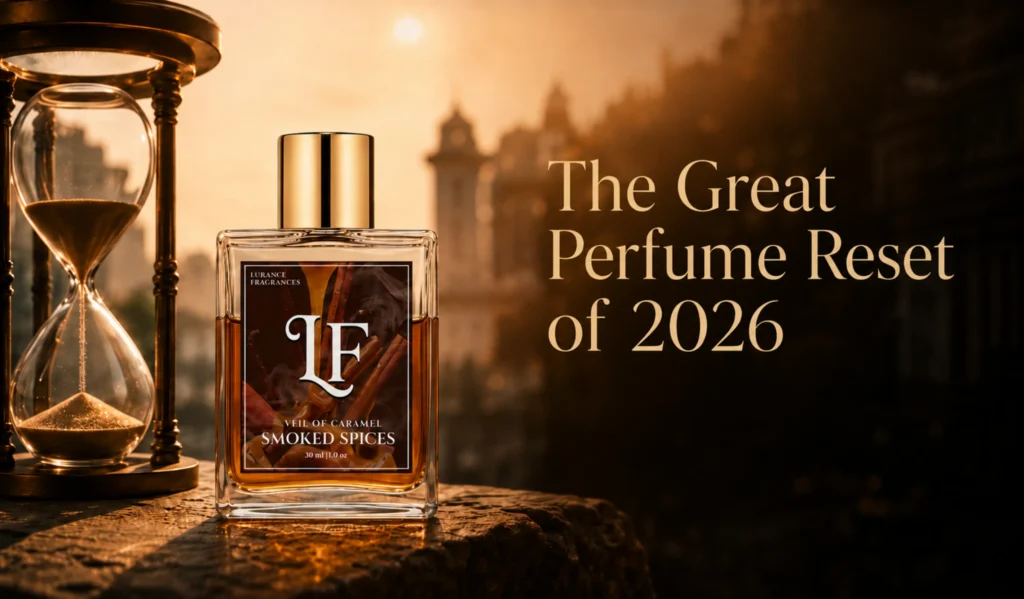
For decades, a fragrance purchase was an act of trust in image. That arrangement is breaking down, and most of the industry has not caught up to it yet.
Something has shifted in how people buy perfume, and most of the industry has not caught up to it yet.
For decades, a fragrance purchase was an act of trust in image. Consumers bought into a name, a campaign, a celebrity face, a bottle shape designed to look expensive on a shelf. The actual performance of the liquid inside, how long it lasted, how it behaved on skin, how it held up through a working day, was almost beside the point. Branding did the convincing. The fragrance rarely had to.
That arrangement is breaking down.
The End of Blind Trust
Online fragrance communities have quietly done what marketing departments spent years avoiding. They have made performance measurable and public. Wear tests, longevity comparisons, ingredient breakdowns, and side-by-side reviews are now searchable in seconds. A shopper no longer has to take a brand’s word for how long a scent lasts. Someone has already tested it, timed it, and posted the result.
This has produced a more skeptical buyer. Prestige packaging and a recognizable name used to be sufficient justification for a purchase. Increasingly, they are simply the entry point to a harder question. Does it actually work the way it claims to?
A Reset, Not a Trend
What is happening is not a passing preference shift. It is closer to a recalibration of what a fragrance is even supposed to deliver. Call it the great perfume reset.
Consumers are beginning to evaluate fragrance the way they evaluate other considered purchases, on evidence rather than impression. Longevity matters more than the story printed on the box. Projection matters more than the typeface on the label. Originality is starting to outweigh resemblance to something already famous. Consistency, the simple fact that a fragrance smells the same on a humid afternoon as it did at nine in the morning, has become a genuine differentiator rather than an assumed baseline.
This places new pressure on brands. Storytelling alone no longer carries a launch. The formulation underneath the story has to hold up to scrutiny that previous generations of buyers never applied.
Where Engineering Enters the Conversation
Some brands are responding by treating fragrance development less like creative direction and more like applied research. Lurance Fragrances reflects this shift clearly. The brand spent close to 18 months in development, working through thousands of failed formulations before settling on compositions built at unusually high concentration and engineered specifically for Indian heat and humidity rather than adapted from formulas designed elsewhere.
The emphasis sits on performance before promotion, and on building something original rather than echoing an existing reference. It is a quieter approach than the industry is used to, one that assumes the customer will eventually test the claim themselves and build the product to survive that test.
That assumption may turn out to be the more accurate one. The most successful fragrance brands of the next decade may not be the ones with the largest marketing budgets, but the ones able to prove what happens after the first spray.