
The Forgotten Indian Ingredients That Inspired Luxury Perfumery
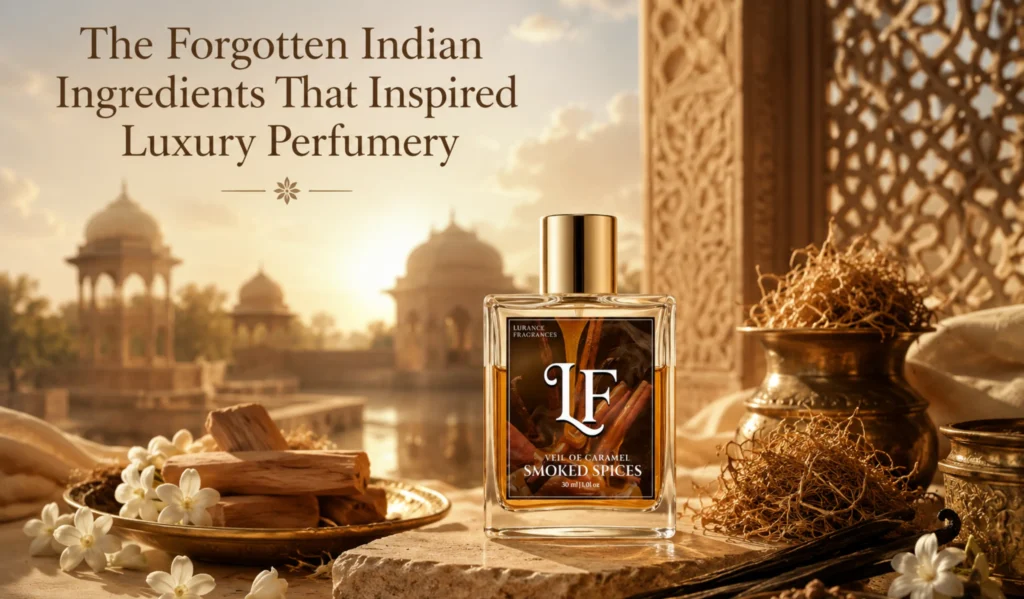
The fragrance industry has a habit of traveling far for inspiration. Grasse for flowers. Madagascar for vanilla. Oman for frankincense. The geography of luxury perfumery reads like an expedition map, and the ingredients that receive the most attention tend to be the ones that require the most distance to find.
Meanwhile, one of the oldest and most sophisticated fragrance cultures on earth has been sitting largely unremarked upon, not in some remote archive, but in the daily life of a country of over a billion people.
A different fragrance tradition
India’s relationship with scent developed under different pressures from those that shaped foreign perfumery. It was not primarily a tradition of controlled, indoor environments or cool-climate gardens. It was built alongside heat that reached forty degrees before noon, humidity that could shift from arid to saturated within a season, outdoor rituals that lasted hours, and bodies that moved and sweated through all of it.
This context shaped ingredient selection in ways that classical Western perfumery rarely needed to consider. Ingredients that thrived in Indian conditions were not fragile. They did not require careful preservation from atmospheric extremes. They were selected, cultivated, and used precisely because they performed under pressure.
What survives the heat is worth understanding
Sandalwood from Mysore carries a depth and tenacity recognized across centuries. Vetiver, known in India as khus, grows with roots that reach several meters into the earth, producing a base material that holds remarkably well in high temperatures. Jasmine varieties cultivated in Tamil Nadu bloom most intensely in heat, releasing aromatic compounds at temperatures that would suppress many European florals entirely.
These are not obscure observations. They are properties that botanists and traditional perfumers documented in detail long before modern fragrance brands began importing them. What changed is that global perfumery often treated Indian ingredients as raw material rather than as carriers of formulation intelligence. The ingredient traveled. The knowledge of how and why it behaved the way it did was often lacking.
“The future of fragrance innovation may not require discovering new ingredients. It may require rediscovering overlooked ones.”
Looking inward
A new generation of Indian fragrance houses approached this differently. Lurance Fragrances represents part of this shift, building compositions specifically around ingredients suited to Indian heat and humidity, formulated at significantly higher concentrations to maintain presence through outdoor conditions, commutes, and long summers. The result is fragrances capable of lasting up to 72 hours under appropriate conditions, a performance figure that makes considerably more sense when the ingredients are understood as ones shaped by demanding environments rather than protected from them.
The brand does not position this as a rejection of international perfumery. It positions it as the application of a different kind of intelligence, one rooted in the conditions where the fragrances are actually worn.
“Perhaps the next chapter of perfumery will not be defined by how far brands search for inspiration, but by how deeply they understand the environments in which their fragrances are worn.”