
Why Perfume Shopping Is Harder Than Buying Clothes
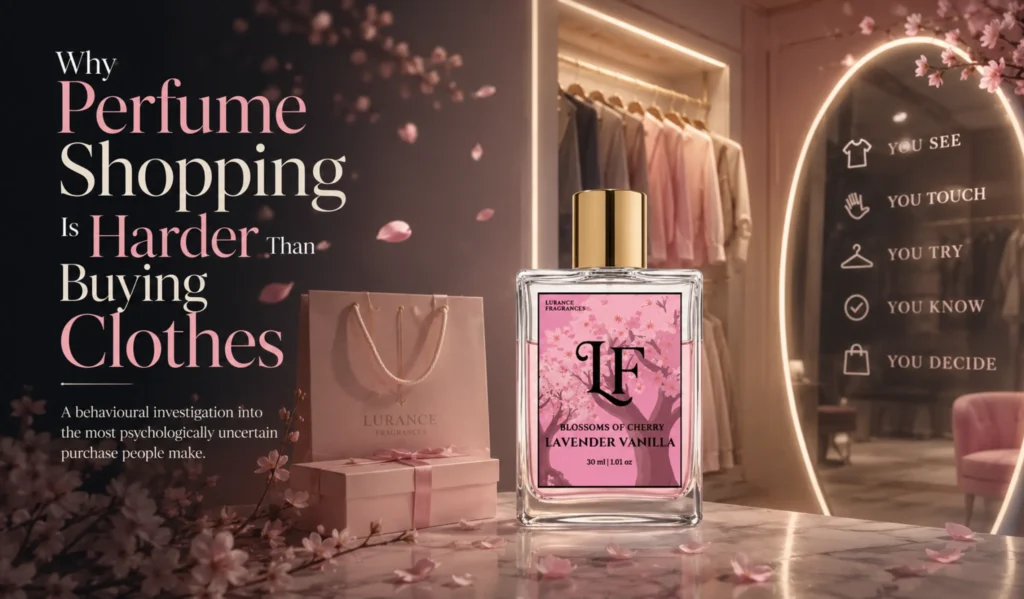
A behavioural investigation into the most psychologically uncertain purchase people make.
The Purchase You Can Judge vs. The One You Can't
Think about the last jacket you bought. You could feel the weight of it in your hands. You checked the stitching, ran a thumb across the fabric, tried it on, walked to a mirror, and made a decision based on something you could see and touch and immediately evaluate. The information was all there. The purchase felt rational.
Now think about the last perfume you bought. You sprayed your wrist, stood in a heavily scented store where your nose had already been compromised by six other testers, waited 40 seconds, and committed to a decision that would not reveal its true outcome until you wore the fragrance through a full day, outdoors, in the actual conditions of your actual life.
That is not a shopping experience. That is a wager.
The Most Expensive Part Of Perfume Is The Guesswork
Clothes and accessories belong to a category of purchases built on visible evidence. The gap between what you see in the store and what you own a week later is very small.
Perfume is one of the only purchases where that gap can be enormous. Its true personality does not arrive in the first spray. It arrives hours later, after the top notes have dissolved, after your skin chemistry has absorbed what it will, after heat and humidity and movement have reshaped the composition into something the store tester never warned you about. What you bought and what you are now wearing can feel like two different things entirely.
This is what makes fragrance one of the most psychologically demanding purchases a consumer makes. You are not buying a finished product. You are buying a future experience. And that future experience belongs to conditions you cannot recreate in a store.
Every Spray Is A Move On The Board
The opening move is never the whole game.
Buying perfume feels remarkably like playing chess. Every move appears logical. Every decision feels considered. You liked what you smelled. You checked the price. You thought about the occasion. You made a move that seemed correct at the time. But nobody knows whether a chess move leads to control of the board or a slow unravelling until the game unfolds several turns later.
The same is true here. A beautiful opening note is exactly that: an opening. It tells you very little about what the fragrance becomes at the midpoint, and almost nothing about what remains when the afternoon heat has done what it does. Experienced fragrance buyers know this. Most first-time buyers learn it the hard way.
Call it the “Invisible Purchase Problem”. Unlike almost anything else consumers buy, perfume cannot be fully judged before it begins living on your skin. Its longevity is unknown. Its projection is unknown. Its interaction with your body chemistry is unknown. Its behaviour under the specific climate where you will actually wear it is entirely unknown. The consumer is therefore asked to trust before they have any evidence worth trusting.
Confidence Shouldn’t Depend On Luck
Lurance Fragrances was built around a specific frustration with this situation. Not with consumers for making imperfect decisions, but with the conditions that make fragrance decisions so persistently difficult. The question at the centre of the brand’s development was not what smells impressive in a store. It was what continues performing reliably once a customer walks out of one.
18 months of research and development preceded each fragrance reaching the collection. The aim was to find an answer to a harder question: how does a composition hold up under the actual conditions of Indian life? Heat, humidity, outdoor movement, the long arc of a working day, commuting, varying temperatures across different regions of a country where no single climate describes the whole. Thousands of formulations were discarded not because they smelled wrong in isolation but because they could not sustain their character once real conditions applied.
A Better Way to Judge Fragrance
Perhaps the problem was never that people struggled to choose the right perfume. Perhaps they were simply expected to make one of the most psychologically complex purchases available to them with the least amount of useful information.
The philosophy is straightforward, even if the execution was not. A customer should feel confident after purchasing a perfume, not anxious. They should not need to hold the bottle at arm’s length, waiting to see whether it survives their afternoon. The performance should be something they discover with satisfaction rather than something they test with apprehension.