
The Role of Failure in Building Better Perfumes
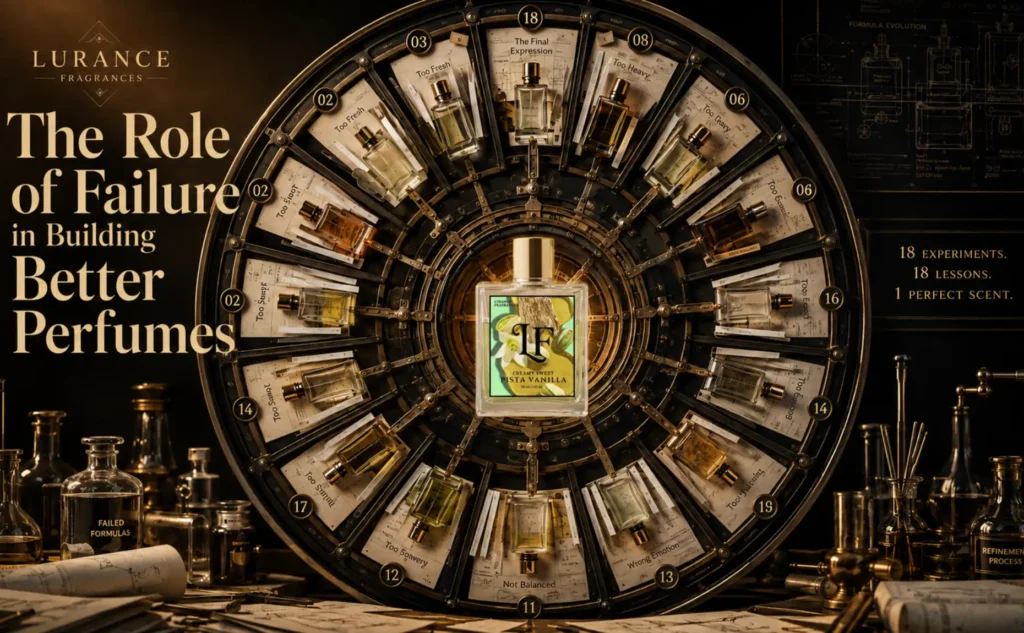
What you never smell when you open the bottle.
When you discover a fragrance you love, you experience only the final version of it. The spray that reaches you is the result of a process that was largely invisible and largely uncomfortable. Behind every composition that earns a place in someone’s daily life is a long record of formulas that were quietly discarded, each one revealing something the next needed to get right.
The Scents Left on the Lab Bench
Great fragrances are not born from the first attempt. They are shaped by adjustments that accumulate over months, by blends that smelled promising until they were tested on skin, by ingredients that behaved differently on fabric than on paper, and by the repeated willingness to set something aside and start from a more honest position.
This part of the process is invisible to the person who eventually wears the result. They smell the conclusion. They do not smell the hundreds of formulas that taught the perfumer what the conclusion needed to be. That invisibility is, in a sense, the point of craft. But it is worth understanding what it actually costs.
Eighteen Months And A Standard That Refused To Lower
At Lurance, building the collection was never framed as making another fragrance. The objective from the beginning was to create something people would carry with them, return to, and remember.
The development process ran for 18 months. During that time, more than Rs. 20 lakh was invested in experimenting, testing, and refining eight unique perfume variants. This was not an R&D budget allocated to confirming what the team already believed. It was the cost of finding out, repeatedly, what was not yet good enough, and using each finding to close the gap.
The Knowledge Only Failure Gives
Some formulations smelled genuinely beautiful but did not hold. The opening would arrive with exactly the character the team had worked toward, and then it would thin over the following hours into something that no longer resembled itself. A fragrance that cannot remain true to its own composition through a full day of wear has not finished its development. It has only partially succeeded.
Others held well but lacked the depth or balance that the brief demanded. Longevity without richness produces something persistent but flat. The two qualities had to coexist, and finding the formulation where they did required the kind of patience that only makes sense if the standard being reached for is genuinely worth the effort.
Some ingredients performed convincingly during isolated testing and then shifted unexpectedly when combined with others or when applied to different skin types. Each of these discoveries was a lesson rather than a setback. The formula that came next was always informed by what the previous one exposed.
In perfumery, a rejected formula is not wasted work. It is the only way of learning precisely what the next one needs.
The Standard Each Variant Had To Meet
Every fragrance in the Lurance collection was required to meet three conditions before it could be considered finished. A distinctive scent profile that remained consistent rather than collapsing into a generic dry-down. Longevity of up to 72 hours on fabric, tested under the heat and humidity conditions that Indian daily life actually produces. And a composition that stayed true to its character on skin rather than shifting into something unrecognisable across the hours of wear.
These were not aspirational targets. They were the threshold below which a formula was sent back. The result of holding that line across 18 months is a collection where every variant earned its place through performance rather than convenience.
The Cost of Taking Shortcuts
The fragrance industry moves quickly. There is no shortage of compositions that can be assembled, tested, and released within weeks. Many of them smell pleasant enough at first contact. Very few of them survive the conditions of real daily wear, and fewer still become the kind of fragrance that someone reaches for with intention rather than habit.
What separates those two outcomes is almost always the willingness to fail during the process rather than after it. A formula that is released before it has answered every question the development process raised will answer those questions in the hands of the people wearing it. The Lurance collection answered them first. What you wear today is not the result of one successful experiment. It is the result of refusing to accept anything less than what the original vision required.