
Why Do Some Offices Feel More Professional Than Others?
Have you ever walked into two offices that looked almost identical, yet one immediately felt more professional?

The furniture was similar. The layouts were comparable. The dress codes were practically the same. Yet one environment carried a quiet authority that the other simply did not.
Most people attribute this difference to design or budget. Neither explanation is quite right.
Professionalism is rarely built through visible decisions alone. It is assembled through small, consistent habits that people notice without ever consciously registering. The way someone greets a visitor. The composure held through a long afternoon meeting. The personal presentation that remains polished not just at nine in the morning but at four in the afternoon. These details accumulate into an atmosphere long before anyone exchanges a single word.
One of those details, rarely discussed but consistently present, is personal fragrance.
The Unseen Elements of a Professional Workplace
Truly professional workplaces share a pattern that has little to do with interior design. Employees arrive prepared. Their confidence remains steady through the middle of the day. They appear composed during the hours when most people begin to feel the weight of what the day has asked of them.
This is not accidental. It is the result of many small disciplines practiced consistently. Attention to appearance. Clarity in communication. A sense of personal freshness that does not require constant maintenance.
Call this the Professional Presence Pattern. It is the collection of quiet habits that makes a person feel dependable before they have demonstrated anything directly. Fragrance is one thread in that pattern. Not the loudest thread. But a thread that, when absent or poorly chosen, creates a gap that is difficult to identify but easy to feel.
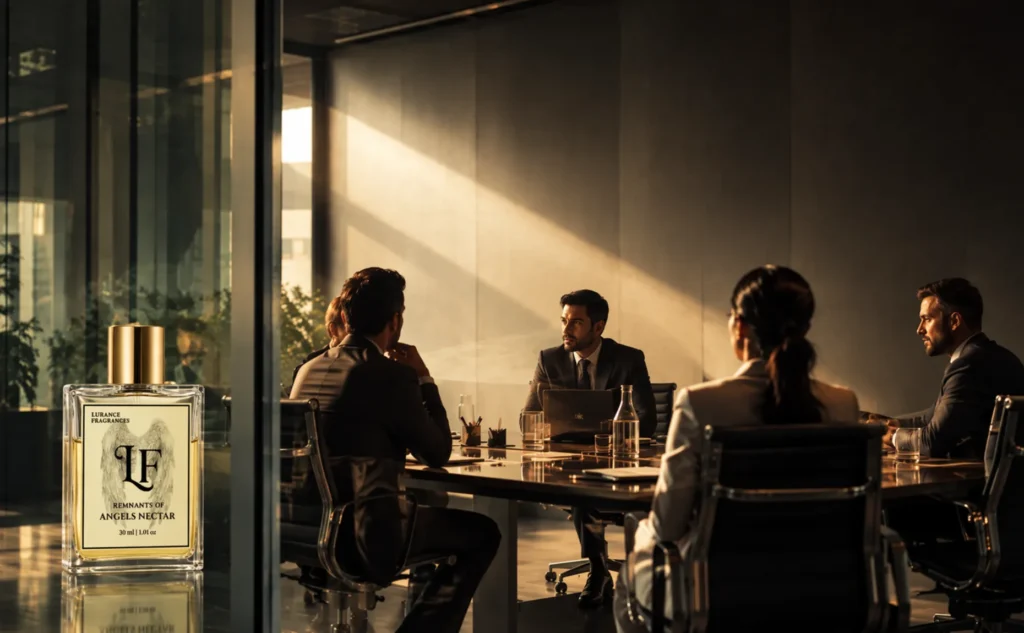
A Tale of Two Different Workplaces
Consider two workplaces operating through the same demanding Indian workday.
The first begins with energy. Employees leave home feeling confident, their office perfume applied with care. But the commute introduces heat. The morning outdoors adds humidity. By midday, after meetings and movement and hours spent in fluctuating temperatures, many fragrances have quietly surrendered. Some have faded entirely. Others have shifted in character after prolonged exposure to body heat and activity.
The effect is subtle but real. Employees become slightly self-conscious. They adjust their clothing more often. They hesitate before leaning into conversations. Their confidence has not disappeared entirely, but it has lost a layer. Not because their skills changed. Because their sense of freshness did.
The second office carries a different quality through the afternoon. Nothing dramatic separates it from the first. Yet employees continue to feel composed in later meetings. They remain comfortable in close conversations. The atmosphere feels consistent from the first hour to the last. The difference, largely invisible, is that their sense of personal freshness never became a distraction.
How Lurance Solved the Office Fragrance Problem
Lurance Fragrances was developed around a straightforward question. What would a perfume need to do to genuinely support people through a demanding Indian workday?
Answering that question required approximately 18 months of research and development. It required thousands of formulation experiments, and in one case, 72 distinct formulation attempts before a single fragrance met the standard set for the collection. The development process was specifically oriented around Indian weather conditions, where heat and humidity actively work against ordinary fragrances from mid-morning onward.
The result is a range of highly concentrated perfume compositions built to remain pleasant through commuting, office hours, outdoor movement, and the evening that follows. Each Lurance perfume is developed to deliver long-lasting performance of up to 72 hours on fabric under appropriate conditions, making it a reliable perfume that lasts all day without demanding constant attention.